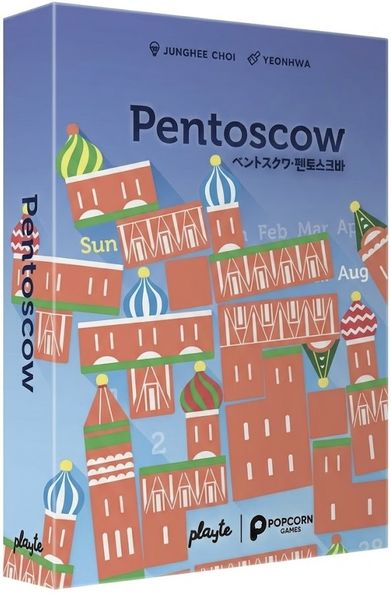
Pentoscow (Import)
| Designer |
Solomon W. Golomb |
| Publisher | Playte |
| Players | 2 |
| Playtime | 10 mins |
| Suggested Age | 7 and up |
This game is in English, Japanese and Korean.
Similar to Pan-Kai by Alex Randolph with two differences.
Pentomino is played on a 8 x 8 grid and contains the 12 pentomino tiles plus 12 cards to distribute six pentominoes to each player before the game.
Players now alternately place one piece per turn on the board, until no tile can be placed anymore. The player who placed more tiles than the other, wins.
The original Pentominoes without the cards and tiles was solved by computers (http://www.msri.org/publications/books/Book29/files/orman.pdf); this version published by Zimpfer in 1969 contains 12 cards to randomly distribute the tiles between the players, making it an all new game.
Pentoscow (Import)
| Designer |
Solomon W. Golomb |
| Publisher | Playte |
| Players | 2 |
| Playtime | 10 mins |
| Suggested Age | 7 and up |
This game is in English, Japanese and Korean.
Similar to Pan-Kai by Alex Randolph with two differences.
Pentomino is played on a 8 x 8 grid and contains the 12 pentomino tiles plus 12 cards to distribute six pentominoes to each player before the game.
Players now alternately place one piece per turn on the board, until no tile can be placed anymore. The player who placed more tiles than the other, wins.
The original Pentominoes without the cards and tiles was solved by computers (http://www.msri.org/publications/books/Book29/files/orman.pdf); this version published by Zimpfer in 1969 contains 12 cards to randomly distribute the tiles between the players, making it an all new game.
Product Information
Product Information
Shipping & Returns
Shipping & Returns
Description
| Designer |
Solomon W. Golomb |
| Publisher | Playte |
| Players | 2 |
| Playtime | 10 mins |
| Suggested Age | 7 and up |
This game is in English, Japanese and Korean.
Similar to Pan-Kai by Alex Randolph with two differences.
Pentomino is played on a 8 x 8 grid and contains the 12 pentomino tiles plus 12 cards to distribute six pentominoes to each player before the game.
Players now alternately place one piece per turn on the board, until no tile can be placed anymore. The player who placed more tiles than the other, wins.
The original Pentominoes without the cards and tiles was solved by computers (http://www.msri.org/publications/books/Book29/files/orman.pdf); this version published by Zimpfer in 1969 contains 12 cards to randomly distribute the tiles between the players, making it an all new game.